 Skip to the content
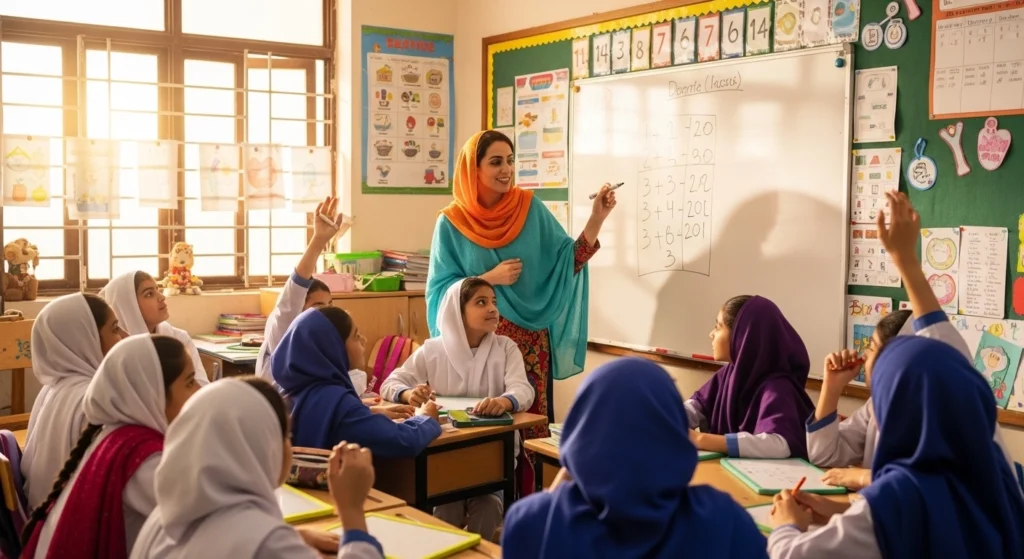
How We Make Mathematics Fun: Innovative Teaching Methods in Wah Cantt
The Subject Every Parent Worries About Most
Ask a room full of Pakistani parents which subject they worry about most for their children and the answer is almost always the same — Mathematics. It is the subject that causes the most tears at homework time, the most anxiety before exams, and the most damage to a child’s academic confidence when it goes wrong.
But here is something that Greenfield teachers have known for years — mathematics anxiety is not inevitable. It is not a personality trait. It is not something some children are simply born with. In almost every case, mathematics anxiety is the result of innovative teaching methods being absent — of a child being taught mathematics in a way that did not connect with how their mind actually works.
At Greenfield Public School, we have made it our mission to change that — for every student, in every class, across both our Model Town and Khanabad campuses in Wah Cantt. Our innovative teaching methods turn mathematics from a source of dread into a source of genuine confidence, curiosity, and even joy.
“Mathematics is not about numbers, equations, or algorithms. It is about understanding.” — William Paul Thurston

Why Traditional Mathematics Teaching Falls Short
Before we explore what Greenfield does differently, it is worth understanding why conventional mathematics teaching so often fails students. According to research on active learning in mathematics, the traditional model — teacher explains, students copy, students practice identical problems repeatedly — produces students who can follow procedures but cannot think mathematically.
They can solve the exact type of problem they practiced. But change the wording slightly, present the same concept in a different context, or ask them to explain their reasoning — and many students are lost. This is not a failure of intelligence. It is a failure of innovative teaching methods — or rather, a failure to use them.
The most common problems with traditional mathematics teaching include:
- Over-reliance on memorisation — students learn rules without understanding why they work
- Fear of mistakes — classrooms where wrong answers are embarrassing produce students who stop trying
- One-size-fits-all pace — moving the whole class at the same speed inevitably leaves some behind and bores others
- Disconnection from real life — abstract numbers on a page feel meaningless to children who cannot see their purpose
- Passive learning — students watching a teacher solve problems rather than solving them actively themselves
At Greenfield, our innovative teaching methods directly address every one of these problems — and the results speak for themselves.
Greenfield’s Innovative Teaching Methods in the Mathematics Classroom
Here is exactly how our mathematics teachers bring innovative teaching methods to life in Wah Cantt — from our youngest primary students right through to Class 10:
1. Conceptual Understanding Before Procedure At Greenfield, we never teach a method before a student understands the concept behind it. Before a child learns the procedure for long division, they understand what division means — through physical objects, visual representations, and real-world scenarios. This conceptual foundation means that when procedures are introduced, they make sense — and students remember them, apply them, and build on them far more effectively.
2. Mistakes Are Celebrated, Not Punished One of the most powerful of our innovative teaching methods is also one of the simplest — we have changed how we respond to wrong answers. At Greenfield, a wrong answer is never met with embarrassment or dismissal. It is met with curiosity: “Interesting — can you walk us through your thinking?” This approach, supported by research on active learning in mathematics, transforms the classroom atmosphere completely. Students who are not afraid to be wrong take more mathematical risks — and mathematical risk-taking is exactly where deep learning happens.
3. Collaborative Problem Solving Mathematics at Greenfield is frequently a team activity. Students work together on challenging problems, discussing strategies, challenging each other’s reasoning, and arriving at solutions collectively. This collaborative approach mirrors how mathematics is actually used in professional settings — and it develops communication skills, logical reasoning, and confidence alongside pure mathematical ability.
4. Visual and Manipulative Learning Across our primary classes especially, our innovative teaching methods make heavy use of physical and visual tools — number lines, fraction bars, geometric shapes, counting blocks, and visual models of algebraic concepts. Abstract mathematics becomes concrete, and concrete mathematics becomes memorable. Students who have physically held and manipulated a concept understand it at a level that no amount of blackboard explanation can replicate.
5. Real World Problem Solving Every week in a Greenfield mathematics class, students encounter problems drawn from real life — calculating costs, measuring spaces, analysing data, working with time and distance. This connection to reality answers the question every mathematics student eventually asks: when will I ever use this? At Greenfield, the answer is always: right now, and here is how.

Real World Mathematics — Making Numbers Mean Something
One of the most effective of Greenfield’s innovative teaching methods is grounding every mathematical concept in the real world that students actually live in. We draw on resources like NRICH Mathematics resources to design problems that challenge students to think — not just calculate.
A Class 4 student might be asked to plan a school event within a budget — adding, subtracting, multiplying, and making decisions with real consequences. A Class 7 student might analyse the water usage of their household and calculate how much could be saved with simple changes — applying percentages and ratios to a problem that genuinely matters. A Class 10 student might work with actual data sets — graphing, interpreting, and drawing conclusions like a real mathematician or scientist.
These are not just clever teaching tricks. They are innovative teaching methods rooted in the understanding that meaning drives motivation — and motivated students learn mathematics faster, deeper, and with far greater joy than students who are simply grinding through exercises.
Innovative Teaching Methods and the Pakistani Curriculum
A question parents sometimes ask is whether these approaches are compatible with the Pakistani board examination requirements. The answer is absolutely yes — and in fact, students who learn through innovative teaching methods consistently outperform those taught through rote methods when it comes to board exam performance.
As outlined in Pakistan’s mathematics curriculum framework, the national curriculum explicitly calls for problem solving, logical reasoning, and application of mathematics to real-world contexts — exactly what Greenfield’s approach delivers. Our students are not just prepared to understand mathematics — they are prepared to perform in exams, because genuine understanding produces exam performance far more reliably than memorisation alone.
Innovative teaching methods and exam preparation are not in conflict at Greenfield. They are the same thing — done properly.

What Happens When Mathematics Becomes Fun
When innovative teaching methods are applied consistently, something remarkable happens — mathematics stops being the subject students dread and starts being the subject they look forward to. We see this transformation at Greenfield regularly. A student who arrived in Class 4 convinced they were “bad at maths” leaves Class 5 volunteering to solve problems at the board. A student who dreaded their Class 9 mathematics exam walks into it with quiet confidence because they genuinely understand what they have learned.
This transformation is not magic. It is the predictable outcome of innovative teaching methods applied with consistency, care, and a genuine belief that every child is capable of mathematical thinking — when taught in a way that respects how their mind works.
At Greenfield, we hold that belief for every single student. Not just the naturally gifted ones. Every one.
Give Your Child a Teacher Who Makes Mathematics Click
If your child is struggling with mathematics — or if they are doing fine but you sense they could love it rather than just tolerate it — come and see what innovative teaching methods look like in practice at Greenfield Public School.
Our mathematics teachers are not just qualified — they are passionate about their subject and deeply committed to making it accessible, engaging, and genuinely enjoyable for every student they teach. Come and meet them. See the classrooms. Watch a lesson.
Admissions are open at both our Model Town and Khanabad campuses.
- Website: greenfield.edu.pk
- Facebook: facebook.com/greenfield.edu.pk
- YouTube: @greenfieldschoolwah
- WhatsApp: +92 313 9995000
Mathematics Is Not Hard — It Just Needs the Right Teacher
The story that mathematics is inherently difficult — that only certain kinds of minds can truly understand it — is one of the most damaging myths in education. At Greenfield, we reject it completely. Mathematics is learnable by every child. It is enjoyable by every child. It is even lovable by every child — when taught through innovative teaching methods that meet students where they are and take them where they need to go.
Whether its O Level or Matriculation system; that is our commitment to every mathematics student at Greenfield. Not just to prepare them for their next exam — but to give them a relationship with mathematics that serves them for life. A relationship built on understanding, confidence, and the quiet satisfaction of a problem solved.
💬 Question for Parents: Was mathematics a subject you loved or dreaded when you were at school? And do you see the same pattern in your child — or something different? Share your story in the comments below — we would love to hear how mathematics feels in your home!
#InnovativeTeachingMethods #MathematicsPakistan #WahEducation #GreenfieldSchool #FunLearning


Leave a Reply